
GUIDE / FLOOR & WALL TILES
Hollow tiles.
Listen before you move in.
Hollow tiles are one of the defects we record most often in new Penang homes. They look perfect and sound wrong. Here is what causes them, how to check every tile yourself, and how to get them fixed while your developer is still responsible.
SHORT ANSWER
A hollow tile has an air gap under it.
A hollow tile is a floor or wall tile with a void underneath, where the adhesive or mortar bed does not fully support it. You find it by tapping: a solid tile gives a short, dull knock; a hollow one sounds drummy and higher-pitched. In a new home bought from a developer in Malaysia, hollow tiles reported in writing during the defect liability period (commonly 24 months from vacant possession) are normally repaired by the developer at its own cost, usually by lifting and re-laying them.
- Check every tile, centre and all four corners, with a tapping rod, a coin or a car key.
- Matters most in bathrooms, balconies, sunlit floors and large-format tiles.
- Record each hollow tile with a sticker or tape, a photo and its room and position.
- Claim in writing early, before renovation, vinyl or cabinets cover the floor.
01 / THE CAUSE
Why a tile
goes hollow.
Tiles are fixed to the floor screed or wall with cement mortar or tile adhesive. When that bed has gaps, part of the tile is left bridging air. The usual reasons on a building site:
- Partial coverage: adhesive applied in dabs or lines instead of a full, notched bed.
- Skinning: the adhesive or mortar was spread too far ahead and had started to dry before the tile was pressed in.
- No back-buttering: large tiles (600 × 600 mm and up) need adhesive on the back of the tile as well as the floor to bed fully.
- Poor substrate: a dusty, uneven or still-wet screed or wall surface that the bed cannot grip.
Not every hollow sound is the same. A small hollow patch at one corner is different from a tile that sounds hollow across its whole face. A good record notes both, with the extent, because the developer's contractor decides the repair.
02 / WHY IT MATTERS
Quiet now,
cracked later.
- Cracking under load. The unsupported part of a tile can crack under a point load: a dropped pot, a ladder during renovation, a heavy cabinet leg.
- Popping (tenting). Floors expand and contract with Malaysia's heat. Tiles with a weak bond are the first to lift or 'pop', sometimes with a loud crack and often near sunlit balcony doors or in large rooms without movement joints. It can happen years after handover.
- Water behind tiles. In bathrooms and on balconies, a hollow tile with cracked grout can let water sit or travel underneath.
- Cost after the defect period. Once the defect liability period ends, re-laying tiles is your cost, and matching tiles from the same batch may no longer be available.
03 / HOW TO CHECK
Tap every tile.
All of them.
- Use a tapping tool. A light metal tapping rod is what inspectors use (CIDB's QLASSIC workmanship assessment uses one too). For a small unit, a coin, a car key or a screwdriver handle works.
- Cover the whole tile. Tap or drag across the centre and all four corners. Hollowness often starts at corners and edges.
- Listen for a change in tone. Compare with tiles you know are solid in the same room. Solid is short and dull; hollow is louder, higher and drummy.
- Mark it. Masking tape or a removable sticker on each hollow tile. Never write on the tile face with a marker.
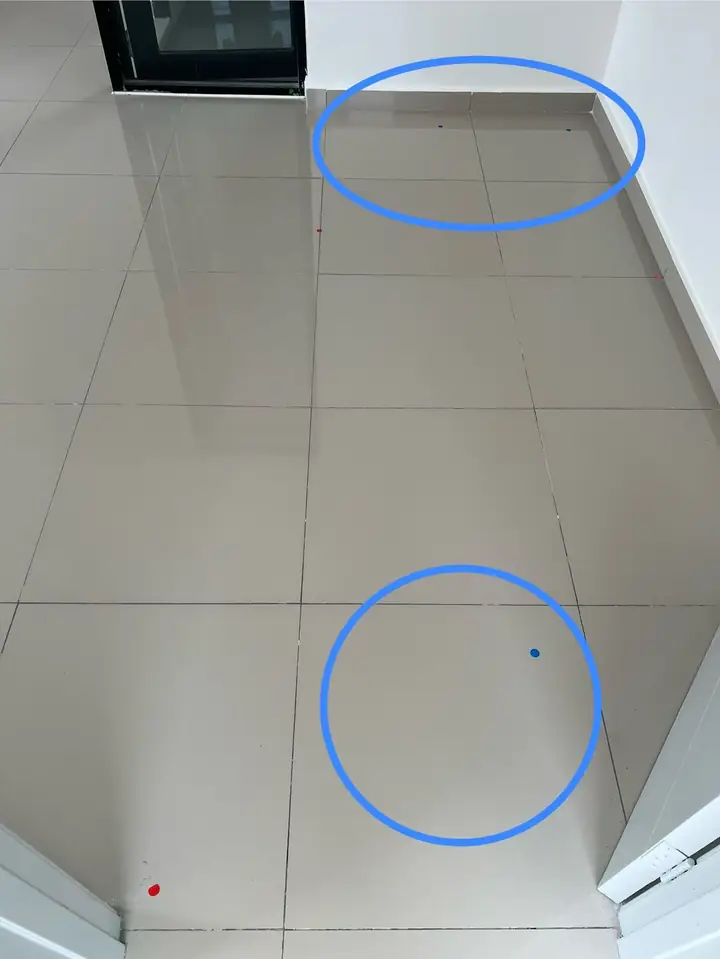
- Photograph it. One wide photo of the floor or wall with the marks visible and a door or window in frame for orientation, plus a close-up.
- Count and locate. Write the room, position and number of hollow tiles: Master bathroom floor, 2nd row from the door, 3 tiles.
Do wall tiles in bathrooms and the kitchen as high as you can reach, and the skirting tiles. Work when the unit is quiet: renovation noise next door and a running air-conditioner both hide the sound.
04 / HOW WE RECORD IT
One sticker
per tile.
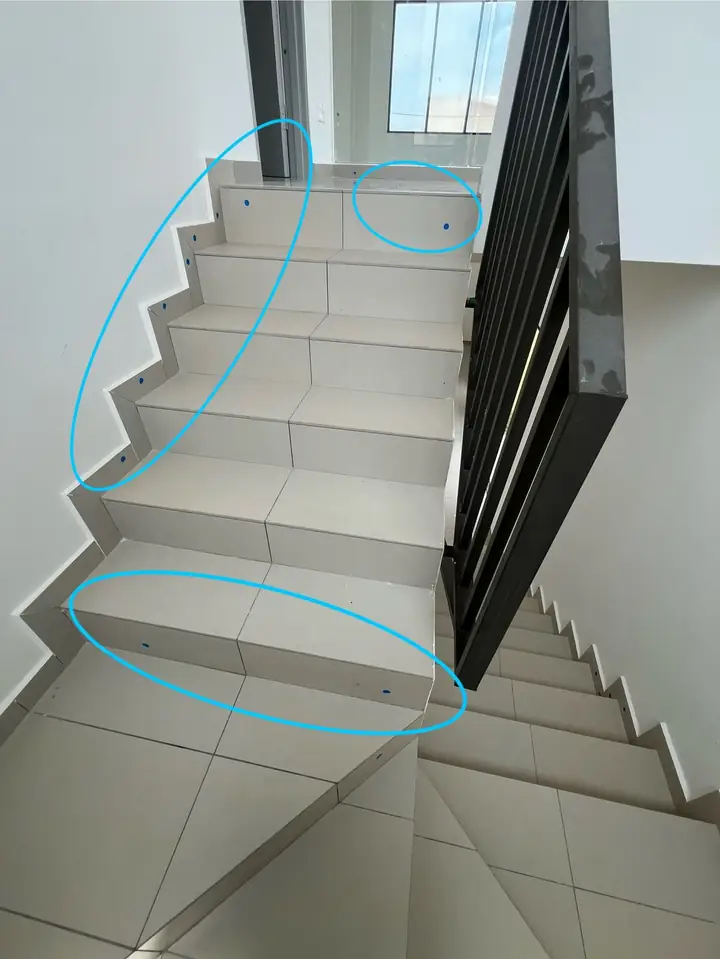
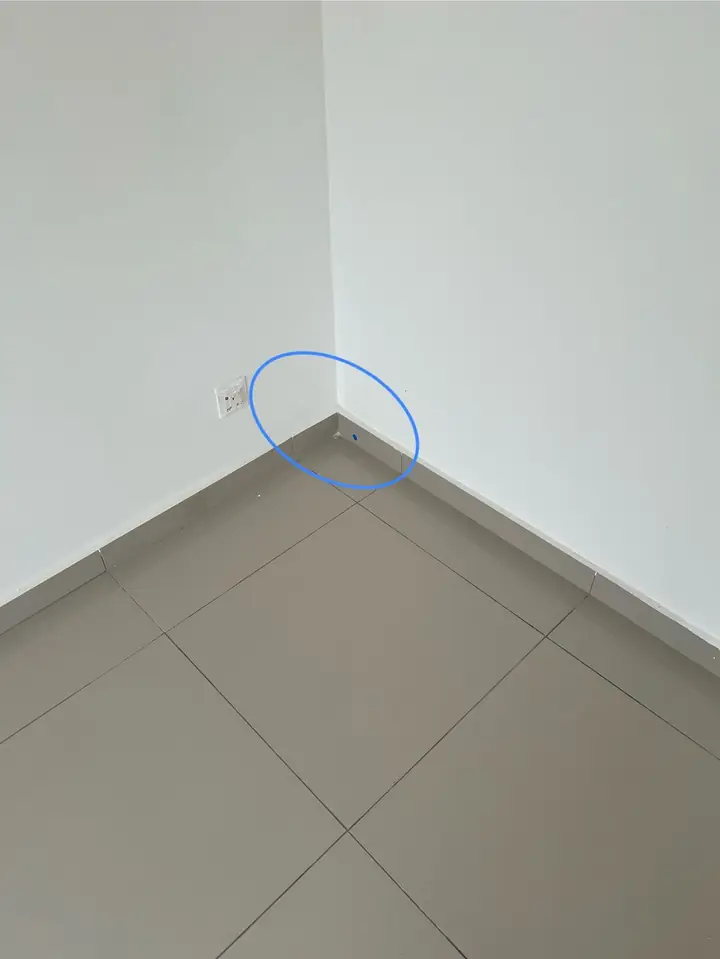
On our inspections every hollow tile gets its own blue sticker, kept separate from the colours we use for cracks and damage (red), gaps and joints (yellow), and finishing and stains (green). Each wall and floor is then photographed with its stickers in place, so the report shows exactly which tiles, and how many, the developer's contractor needs to attend to, without anyone re-tapping the whole floor.
This is also why we ask for an empty unit. Tiles under boxes, rugs or furniture cannot be tapped, and they cannot go into your defect list.
05 / GETTING IT FIXED
Claim it inside
the window.
- Submit in writing during the defect liability period, with the photos and locations. Under the standard agreements the developer generally has 30 days from receiving your written notice to repair.
- Ask about matching tiles. The usual fix is to hack out and re-lay the hollow tiles. Ask for tiles from the same batch so the shade matches, and whether spare tiles were handed over with the unit.
- Re-check the repair. Tap the re-laid tiles and their neighbours (hacking can disturb adjacent tiles), and check the grout colour and that edges are level.
- Before you cover it. Planning vinyl, timber or built-in cabinets over the tiles? Record and submit hollow tiles first; once covered they can no longer be shown.
REAL EXAMPLES
What hollow tiles
look like on a report.
From a real inspection in October 2026. Tiles look fine until they are tapped, so we mark each hollow tile with a small blue sticker, photograph it and circle it in blue in the report. That report listed 13 hollow items, on floors, skirting, walls, stairs and a bathroom kerb.
Prefer to watch? See how a hollow tile check is done on our TikTok.
QUESTIONS
Quick
answers.
Something else on your mind?
We're a message away.
Is a hollow tile a defect the developer must fix in Malaysia?
For a new home sold under Malaysia's standard sale and purchase agreements (Schedule G for landed homes, Schedule H for strata units), defects that appear during the defect liability period, commonly 24 months from vacant possession, and are reported in writing are the developer's to repair at its own cost. Hollow tiles are routinely reported and rectified this way. Your own SPA sets the exact terms.
How many hollow tiles are acceptable?
The standard agreements do not set a number. CIDB's QLASSIC workmanship standard (CIS 7) checks floor and wall finishes with a tapping rod, and the requirement is no hollow or drummy sound, but QLASSIC is a scoring system for workmanship, not a legal threshold for claims. In practice, record every hollow tile with its location and let the developer's contractor decide the repair.
Can hollow tiles be repaired without hacking them out?
Sometimes contractors inject epoxy or grout into the void through small holes or the grout joints. It avoids replacing tiles but is harder to verify. For wet areas and tiles that are hollow across their whole face, lifting and re-laying is the more common fix. Ask which method is proposed and re-tap the tiles afterwards.
Can a hollow tile pop up years later?
Yes. Tile popping, where a tile or a row of tiles lifts into a tent shape, is common in Malaysian homes and often appears in sunlit areas. A weak bond (hollowness) and missing movement joints both contribute. If it happens after the defect liability period, the repair is usually at your own cost, which is why it pays to check early.
Should I check for hollow tiles in a subsale home?
Yes. There is no developer defect period on a second-hand purchase, so hollow, cracked or popped tiles become part of your price negotiation or your renovation budget. A pre-purchase inspection records them before you commit.
SOURCES & LIMITS
Where this
comes from.
QLASSIC is the Construction Industry Development Board's quality assessment system for building workmanship (standard CIS 7), see cidb.gov.my. Defect liability terms: the standard Schedule G and H agreements under the Housing Development (Control and Licensing) Act 1966. This guide is general information for Malaysian homebuyers, not legal advice. Your own sale and purchase agreement (SPA) sets the exact periods and procedure; for a dispute, speak to a lawyer or the tribunal.
Want every tile tapped?
We tap every accessible floor and wall tile and photograph each hollow one with its location. Send your development and unit type for a quotation.
Book a tile check